


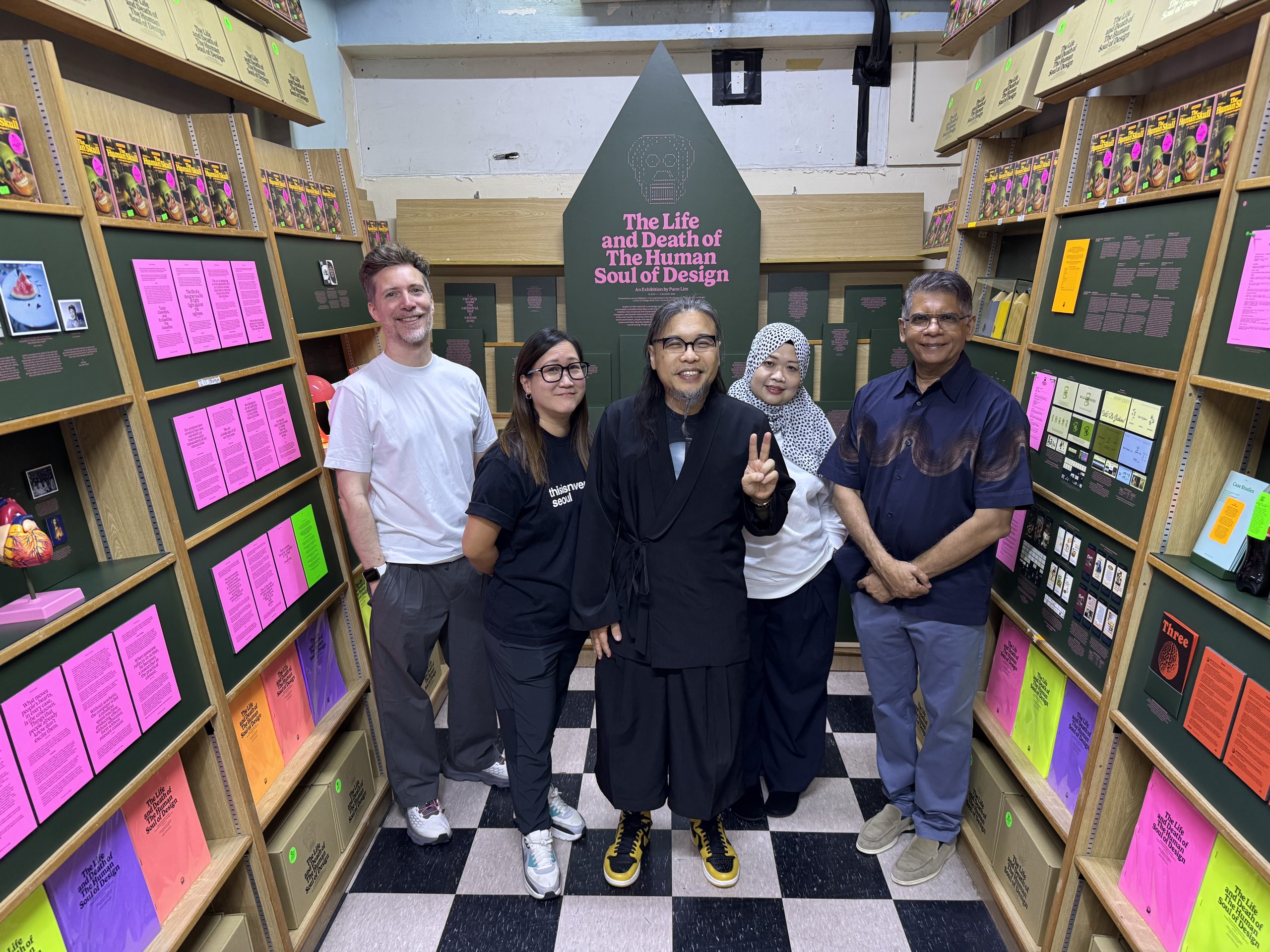
Pann Lim (centre) at his thesis exhibition at Basheer Graphic Books with (from left) Lecturer, Andreas Schlegel, MA Design Programme Leader, Joselyn Sim, Dean, Faculty of Design, Associate Professor Nur Hidayah Bte Abu Bakar and LASALLE President, Professor Venka Purushothaman.
In conversation with: MA Design graduand Pann Lim on the simple question that led him to pursue an MA
23 Oct 2026
Despite having 28 years of design practice—and countless design accolades—under his belt, creative director Pann Lim found himself stumbling in recent years over a simple question from young students and parents: should people still pursue further studies in design?
It ought to have been a straightforward yes-or-no answer. In fact, five years ago, Pann’s answer would have been an immediate, “Just go for it.” But with AI-dominating the headlines and its encroachment into the creative space, Pann found himself beating around the bush and giving answers he himself found unconvincing.
View this post on Instagram
Uneasy about this, Pann felt that he needed to know more. To dive deeper into the topic, he made the decision to apply to LASALLE’s MA Design programme.
We visited Pann at his thesis exhibition at Basheer Graphic Books and asked him about the challenges of returning to school as a working professional, his advice to other professionals considering applying to the MA Design programme, as well as what his new answer would be to the young people considering studying design in this age of AI.
What made you choose to do this research within the structure of the MA Design programme, instead of pursuing it as a personal project?
Of course, one way would be to self study. But something told me that I should go further. And to do that meant intentionally taking time off. That’s why I enrolled in the MA, so that my clients’ deadlines will not always come first.
Being very obsessed with work, I got deeper and deeper. In the end, I think this research became something that was pretty important to me. I unraveled more information than I thought I knew, which is great—I think research work is supposed to do that. So that’s the main reason, pretty much.
To me, what’s important throughout this one year of research is to have more grounded data and information, because basing theories on my own personal intuition is not good enough. With proper research into what makes the human designer irreplaceable in the age of AI, maybe my replies or my answers will be a bit more grounded.
What else were you looking to get out of the MA, other than space to do research?
I feel like what the MA rewarded me with was the knowledge and also the chance to learn new skills. You know the Chinese saying, “活到老学到老”? Lifelong learning is something that I’ve never once shied away from.
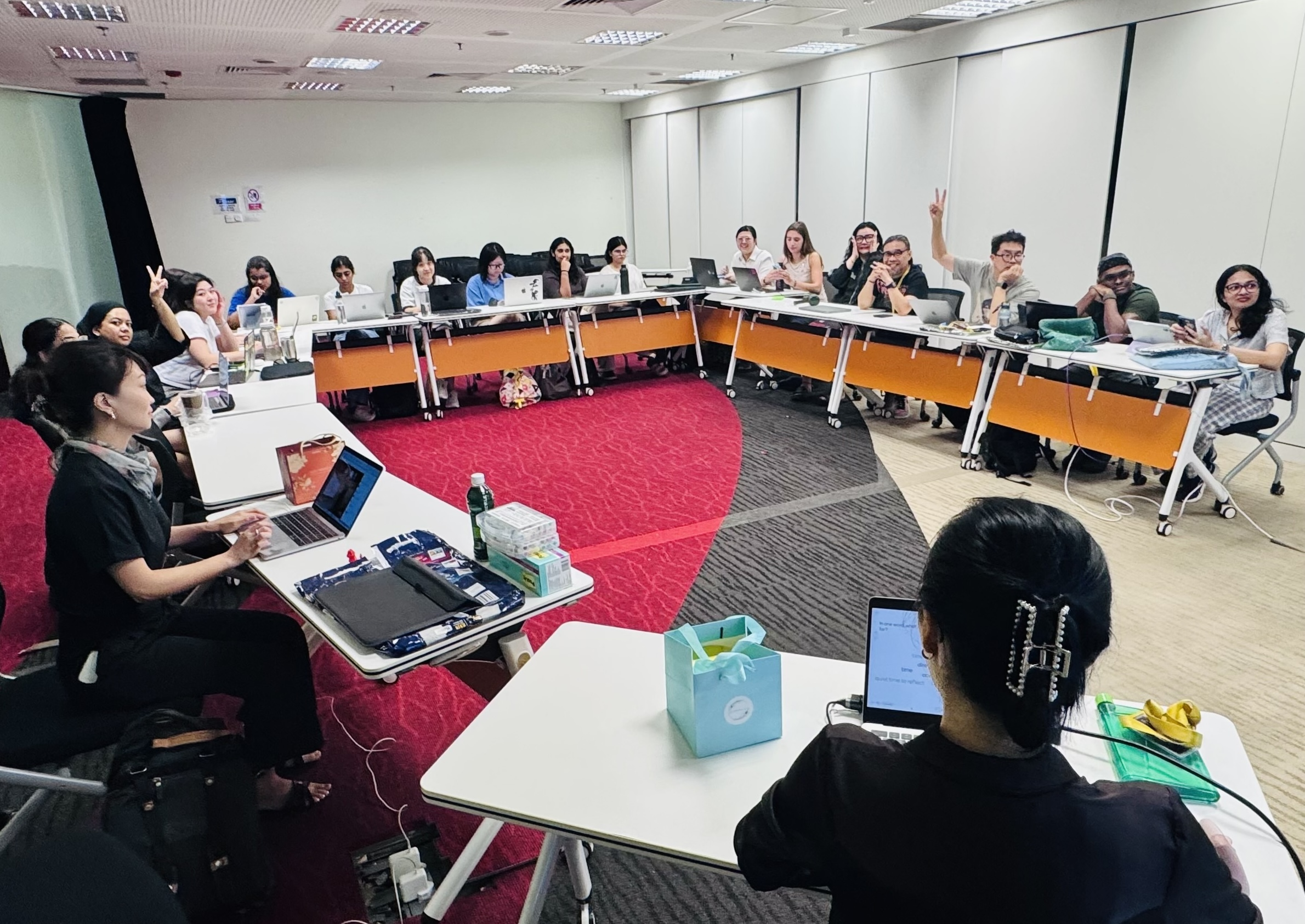
Pann and his classmates attending the Agora module, taught by adjunct lecturer and MA Design alumna Kathy Anne Lim (first from left).
And that also stems from the way I look at things. I mean, we have all been students before. I think maybe 30 years ago, in class, sometimes some lectures are not as inspiring and your peers will always say, “Oh, so-and-so is not so inspiring.” But then I feel that the lecturer must have also still known more than us, right?
So instead of thinking about whether you know more than them, you must think of the areas that you do not know and try to extract those things.
So for me, my whole approach to taking this course is to extract all that information and years of experience that I do not have from my supervisors. That is actually the gap which you need to look at. What’s the point of learning if you already know everything? There’s nothing to learn.
I think that’s what I found very fulfilling when I’m pursuing this course, actually.
At the same time, I think everyone pursues further studies for their own reasons. Personally, what matters to me is doing this research which hopefully can impact people, even in the smallest way.
So the MA was killing a few birds with a single stone: I was fulfilled by learning new skills while at the same time able to hopefully contribute to the creative industry. This was what I looked forward to.
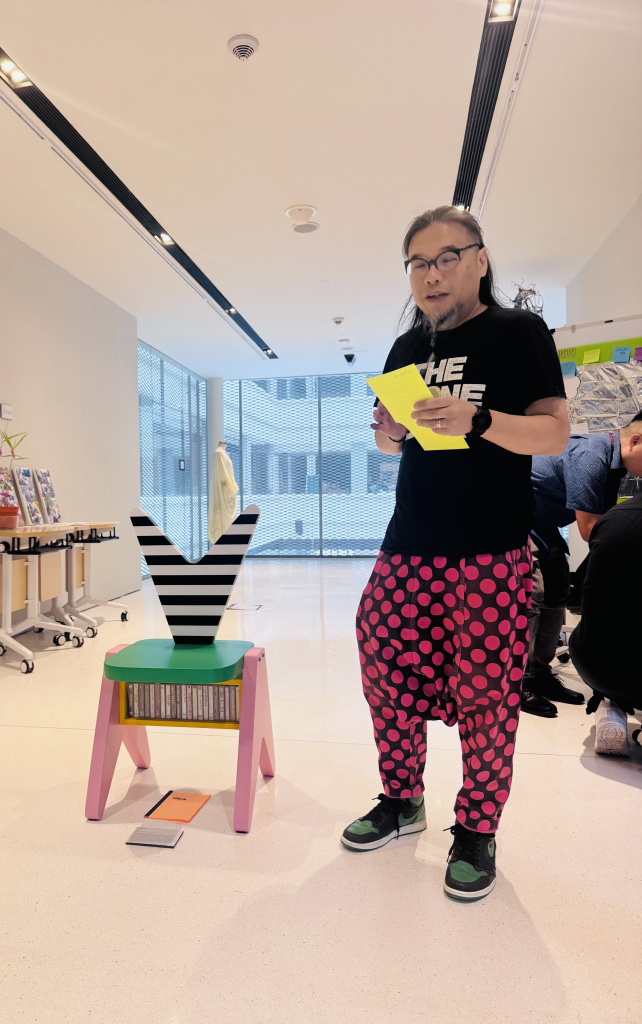
Pann presenting a chair he fabricated in response to the theme “Who am I?” as part of the Agora module’s assessment. The chair was exhibited at The “Who am I?” Festival.
What was challenging about coming back to school?
As a working professional, you’re used to having a team of people when we work—writers, designers, art directors.
So now, just imagine doing more than five persons’ work by yourself. You have to do the research, writing, design, copy proof, even project managing and account servicing, where your clients are your supervisors or lecturers.
But that didn’t deter me, because I think it’s nice to know that after almost 30 years of practice, we are able to still take instructions. We are able to feel good about brainstorming with everyone at all levels.
Even feedback was not a chore or a hurdle. My mindset has always been that feedback doesn’t mean you have to agree with it totally; it is for you to look at another person’s perspective. If you still feel that what you are doing is correct, then it is also up to you as a person to come back, re-present and convince. If you have an outcome without conviction, then it’s hard to get people to understand your point of view.
So I took everything, I would say, positively. Personally, I think through the process there were so many areas where I was really touched and happy. I feel that the experience itself is very human and that is linked to my project as well—what makes us irreplaceable as humans.
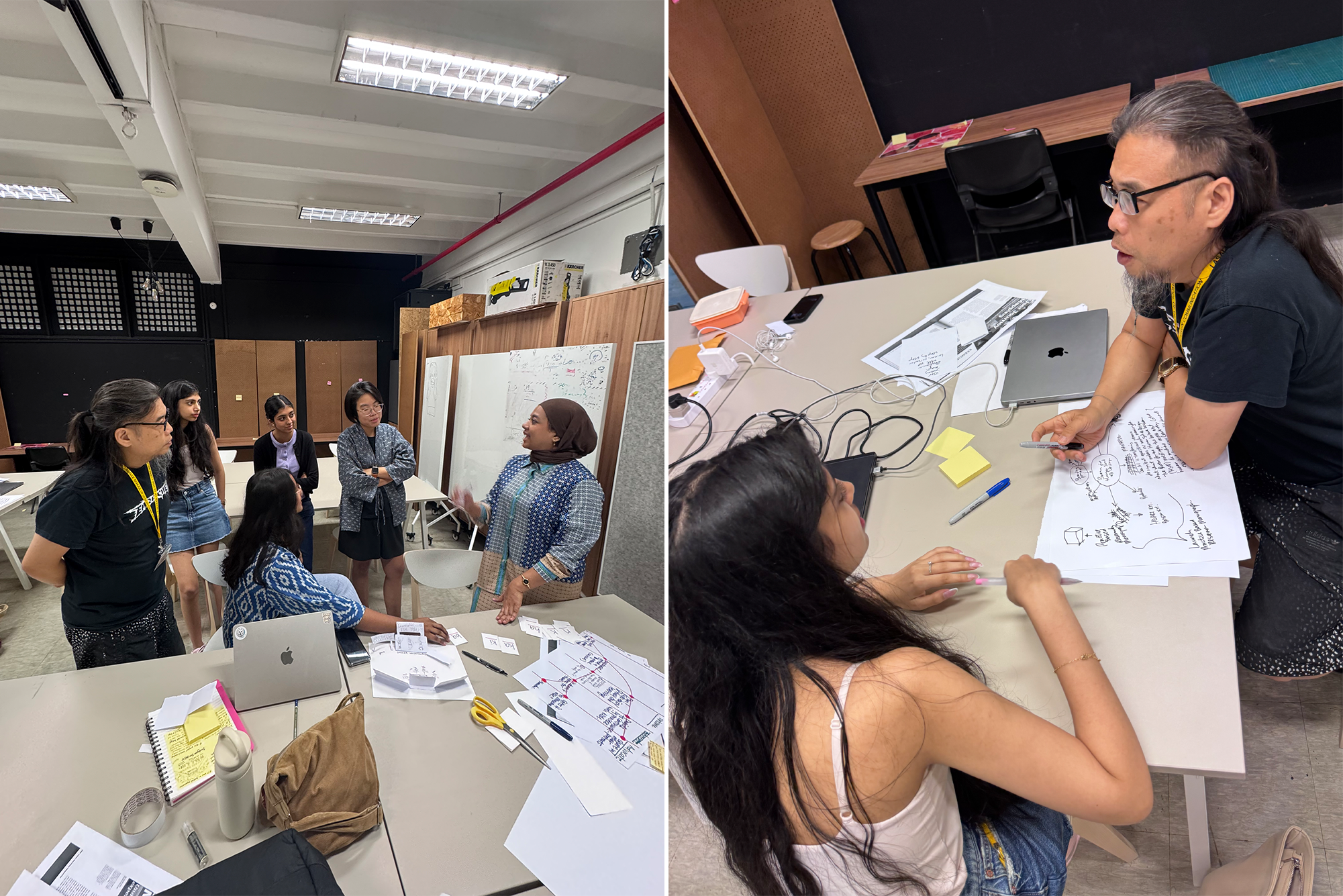
(left) Pann listening to classmate Masturah Maidin (first from right) share her project progress; (right) Pann working with classmate Gunika Jain (left) engaging in a Design for Social Change workshop.
Did anything surprise you in your research?
I wouldn’t call it surprising but I will share that a nice thing which happened was that the research managed to go beyond Singapore’s shores—for which I have to thank the respondents from more than 20 countries.
While the size is still small, I do think that it’s a good indication that more than 94% of the people who responded agree that human authority cannot be stepped away when using the AI. I think this information is important. It means that we know that the tool is there to serve us, but we are there to control it. We have to make sure the outcome is still us.
And that’s why sometimes, when you look at some work done by AI, it still looks pretty good or decent, while some just looks totally terrible. I think the main thing behind this difference is that we as humans need to be behind this. So I think that’s one positive outcome from the research.
The other thing is that I’m still collecting information, even though the deadlines are over. My online response form is still live; every other day, I still go in to see new things.
I’ve already found some more information that I need to update. And this update won’t happen for now, because everything is printed and presented for final submissions. But I plan to maybe publish another—I don’t know—likely a book in 2028 to maybe contradict my first finding a little?
I think that that’s a nice part about research, right? You are not ‘right’ until the end of the research process.
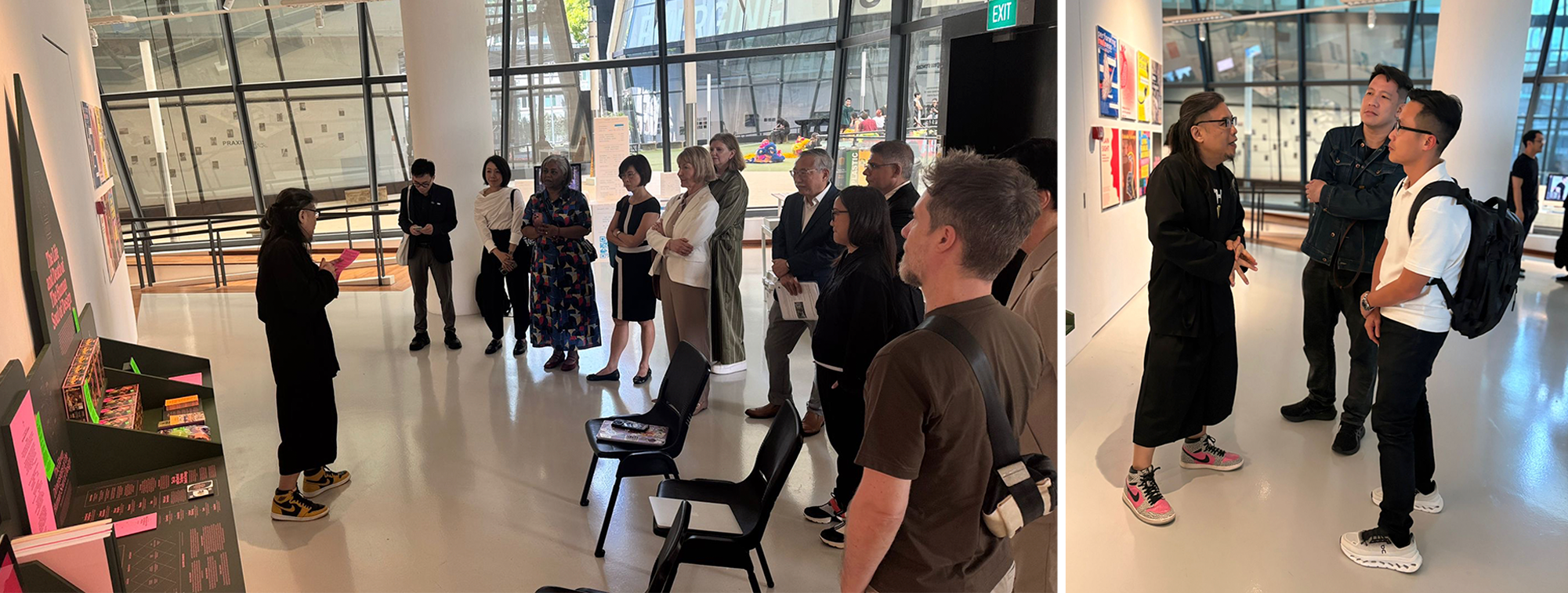
(left) Pann talking about his research project through a Viva Voce presentation at INTERLUDE 2026: An MA Design work-in-progress showcase. His presentation coincided with a visiting delegation from Central Saint Martins College of Art (CSM), including Professor Karen Stanton, Vice-Chancellor and Professor Rathna Ramanathan, Provost of CSM and Executive Dean for Global Affairs. (right) Pann discusses his work with lecturer David Lee and MA Design alumnus Ang Sheng Jin.
How did you manage your time?
So, running so many things at the same time, to be frank, is not tenable.
After one semester, I knew that actually if I were to just finish my assigned work, turn up and submit everything on time, the programme is manageable.
But after looking at the initial research, I did feel that there’s a likelihood that it could contribute to the industry. If that’s the case, then there’s no time for me to slow down. I actually need to go faster.
So because of that, I actually had a meeting internally in the office and I told them I’m going to take a few months off so that I can fully concentrate on this.
And because I really wanted to do more and reach more people, I went ahead to publish a book first, which is the skull box. By doing that, I could officially do a book launch here at Basheer as well as at [renowned British magazine shop] magCulture when I was in London to judge D&AD. When I came back to Singapore, I also liaised with Temasek Polytechnic to do yet another book launch there.
View this post on Instagram
All these in-person, small events allowed me to reach further at a faster pace. At Temasek Poly, I was able to reach at least 100 students and I received like 60 to 70 responses. Then when overseas, I was lucky to also reach out to people outside of Singapore. Some of them even posted about it which helped it go further.
So I think the research benefited from a few instruments at play at the same time, which let me reach more people in a shorter time so that my research can be a bit more grounded.
I admit that the limitations are still there; but I feel as a starting point, it’s encouraging for me.
What would be your advice then for other design professionals who might be considering applying to the MA Design at LASALLE?
My advice to others will be: find something that you truly want to research. For me, not being able to answer people in the most honest way that I could really pushed me to further this.
If you are not authentically connected to that topic, then don’t do it, because even though the programme is a year or two—depending on whether you are doing the programme full time or part time—it’s still a long time to face that same topic. That’s my take.
For me, I felt like there was never a moment which was too hard to handle. Even at the toughest time, when time was short and research results were not coming in on time and whatnot, because I truly believe in this pursuit, it didn’t deter me at all.
So think of something that you really want to pursue. As long as you have something passionate that you want to do, then I think the journey will be quite smooth.
You said that this whole thing was sparked off by receiving emails from young people about whether they should pursue design in this age of AI. Prior to your MA, you didn’t know what your answer would be. Do you have an answer for them now?
Oh yeah, I do.
So during that one year’s search and research, I, of course, found my answers to these questions.
Truth be told, AI is here to stay. If you are open-minded and feel that you might use the tool once in a while to maybe improve certain work processes to make them more streamlined, then yes, please pursue design. If you reject the platform 100%, then don’t do it. Because I think AI is here to stay; for better or for worse, it’s here.
I think, as of now—because we wouldn’t know how AI will advance—I still feel like it’s quite hard to replace our human sensibilities. I mean: there’s still a lot of things that we do, like intuition or serendipity. Projects sometimes rely on serendipity, like four elements coming together—one from a memory 40 years ago, one could be from a conversation we’re having now, plus a colour you just saw, plus a flower. And these four things combine into one.
How are you going to transform these into AI prompts? There is no way you can prompt them. And how are you going to know which area and faculty of your mind you have to use to recall this information?
There is no way. So I think there are still a lot of things that we can create nicely.
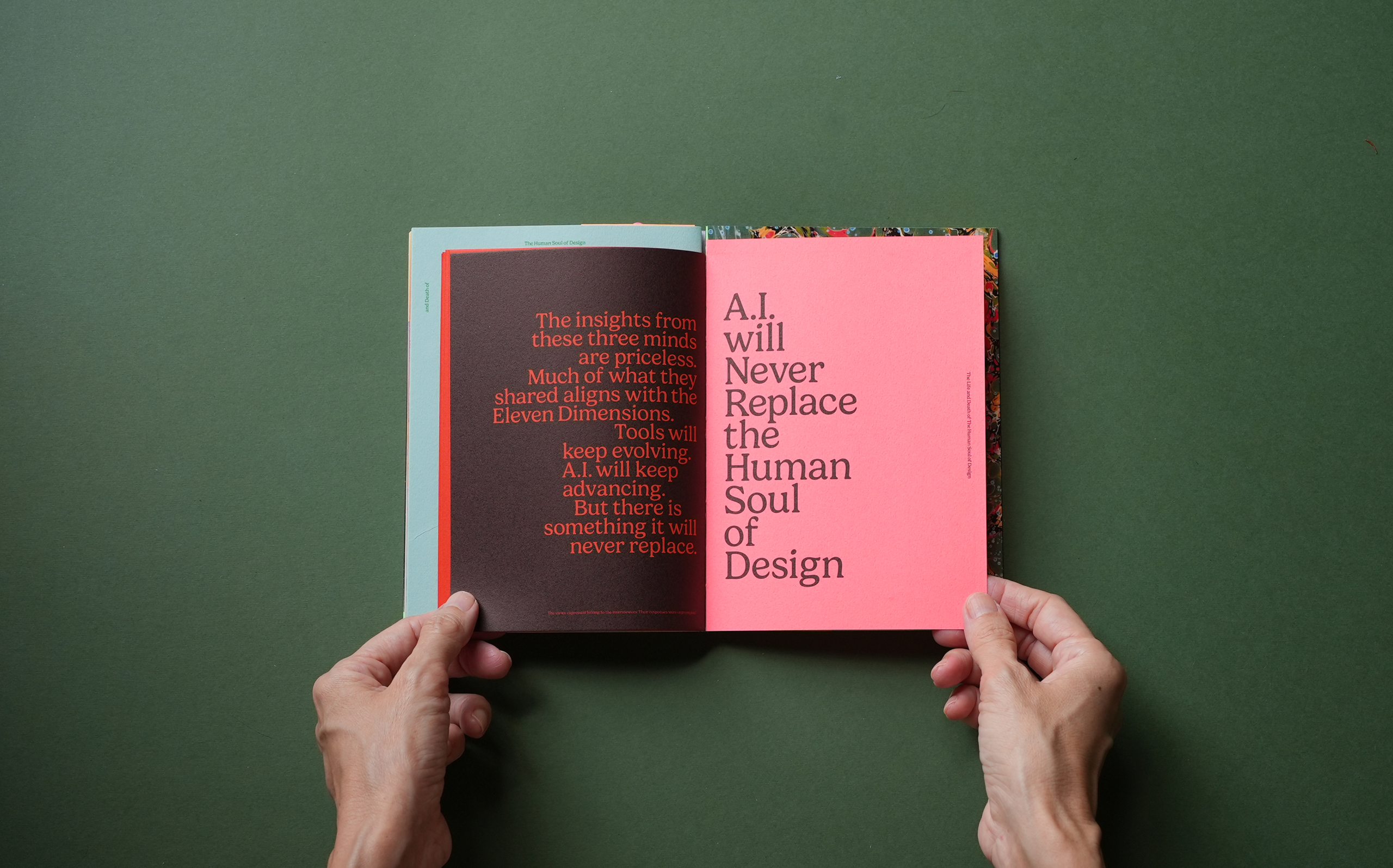
A flat lay of Pann’s publication. Image courtesy of Pann Lim.
This interview has been edited and condensed for clarity. You can follow the evolution of Pann’s research through his platform the Bureau for the Human Soul of Design via Instagram.
Push beyond what you know and explore new possibilities. Get a first-hand look at postgraduate study through The Postgrad Experience and explore the practice and research cultures of LASALLE’s MA programmes.
Sign up for The Postgrad Experience Apply now
Related stories
Trip report
Wandering and wondering at humanity: BA (Hons) Arts Management represents at Ars Electronica 2026
13 Oct 2026
Trip vignettes by Amila Khairana Binte Abdul Rahmat, Angela Kristie Rustham, Muhammad Haris Bin Muhammad Shahril, Shernice Sah Jia Yi and Vina Tan Ding Kiang. … Before this, Echoes of …
In conversation with
In conversation with: Kyle Balda, director of Minions, Despicable Me 3 and The Sheep Detectives
7 Oct 2026
In June 2026, the Puttnam School of Film & Animation, in partnership with Cartoons Underground, hosted animation director Kyle Balda for a masterclass with students. Balda is a director and …
What to expect in LASALLE
Global Creative Dialogues: Cross-university collaborations and knowledge exchange in fashion, illustration and technology
6 Oct 2026
This article was originally written for and published in HKBU AVA Magazine #15 (September 2026) and is reproduced with permission. From August to November 2025, “Stories From Our Wardrobe” brought …
In conversation with
In conversation with: Kamila Andini on filmmaking as a record of personal discovery
31 Aug 2026
Kamila Andini is one of Southeast Asia’s most distinctive voices. From her acclaimed debut feature The Mirror Never Lies (2011), The Seen Unseen (2017), Yuni (2021) and Before, Now & …